The Prusa XL is freaking awesome. It has a big build volume, up to five independent print heads, and a tool-changing system that makes the mechanical engineer in me very happy. The movements, the sounds, the whole thing is just cool.
There is one tiny problem: I have a hard time figuring out who should buy it.
That sounds ridiculous for a machine this capable. But an impressive piece of engineering is not automatically a compelling purchase, especially when the competition is moving this fast. The XL, along with the MK4, has me worried that Prusa could become the BlackBerry of consumer 3D printing: a beloved pioneer that keeps improving its products while the market moves somewhere else.
I am not saying that because I dislike Prusa. Quite the opposite. I built a print farm around its printers. I want this company to win.
Prusa Helped Build the Market It Now Has to Defend
Back in 2012, Josef Prusa released an open-frame printer design that helped change consumer 3D printing. Variations of that design spread everywhere, and Prusa’s open-source philosophy helped accelerate development well beyond its own machines.
Just as importantly, those printers earned a reputation for reliability. I joined the club in 2018 when I built my first Prusa i3 MK2, and eventually trusted the brand enough to put a whole bunch of its machines to work.
Prusa also managed something that is hard to manufacture: a genuine sense of community. Despite growing into a substantial business, it still felt like the people’s printer company. Alongside early players such as MakerBot, it helped make this whole consumer 3D printing world possible.
Then Bambu Lab showed up.
The X1 felt like the iPhone moment for 3D printing. Suddenly, the quirky, open-source-friendly machine that enthusiasts loved had a competitor offering a much more polished, appliance-like experience.
Think Woody meeting Buzz Lightyear. Except Buzz also prints your parts considerably faster.
Bambu Lab Changed What People Expect From a 3D Printer
The biggest thing Bambu Lab brought to the market was not simply speed. It was making 3D printing feel less like a science experiment and more like an appliance.
Historically, a genuinely hands-off experience usually meant spending serious money on industrial equipment. Bambu helped bring that expectation into much more affordable consumer machines, while delivering printing speeds that felt two or three times faster than what many people were used to.
That changes the buying decision. A newcomer does not necessarily care how influential your open-source design was. They want to get a part off the machine without turning printer maintenance into a second hobby.
My concern is that Prusa enjoyed a strong position for so long that its pace of improvement stopped matching the pace of the market.
To be clear, my suspicion that the MK4 and XL were pushed out under competitive pressure is speculation, not inside information. I do not know what happened in Prusa’s product meetings. But from the outside, the releases felt reactive rather than like a confident leap ahead.
And as someone who likes the company, that is frustrating.
What the Prusa XL Actually Does Well
Forget the competition for a minute, and the XL makes a strong impression. Its advantages are real.
A genuinely useful build volume
The XL offers a build area of approximately 36 × 36 × 36 centimeters, or just over 14 inches in each direction. That gives you room for fairly large parts or a bed full of smaller ones.
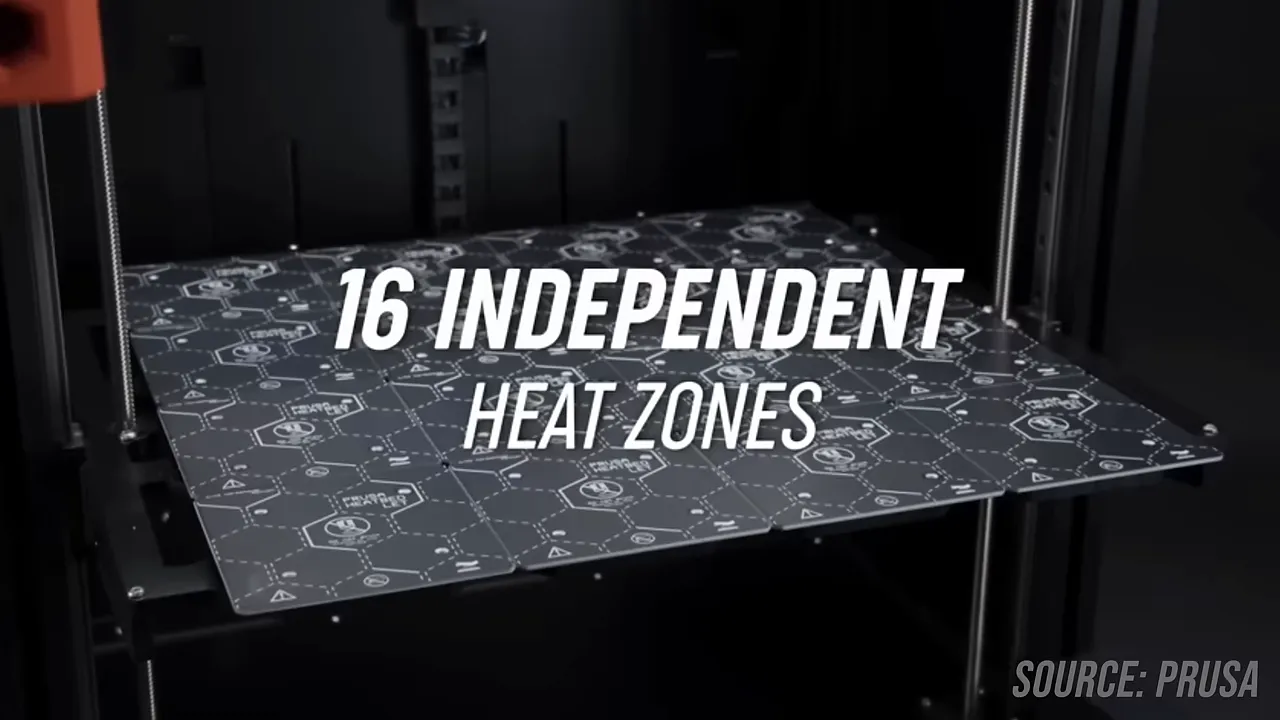
Its segmented heated bed is another smart touch. Rather than heating the entire surface for a small part, the machine can heat the area it needs. That is a sensible feature on a printer with this much bed space.
Independent tools are the real differentiator
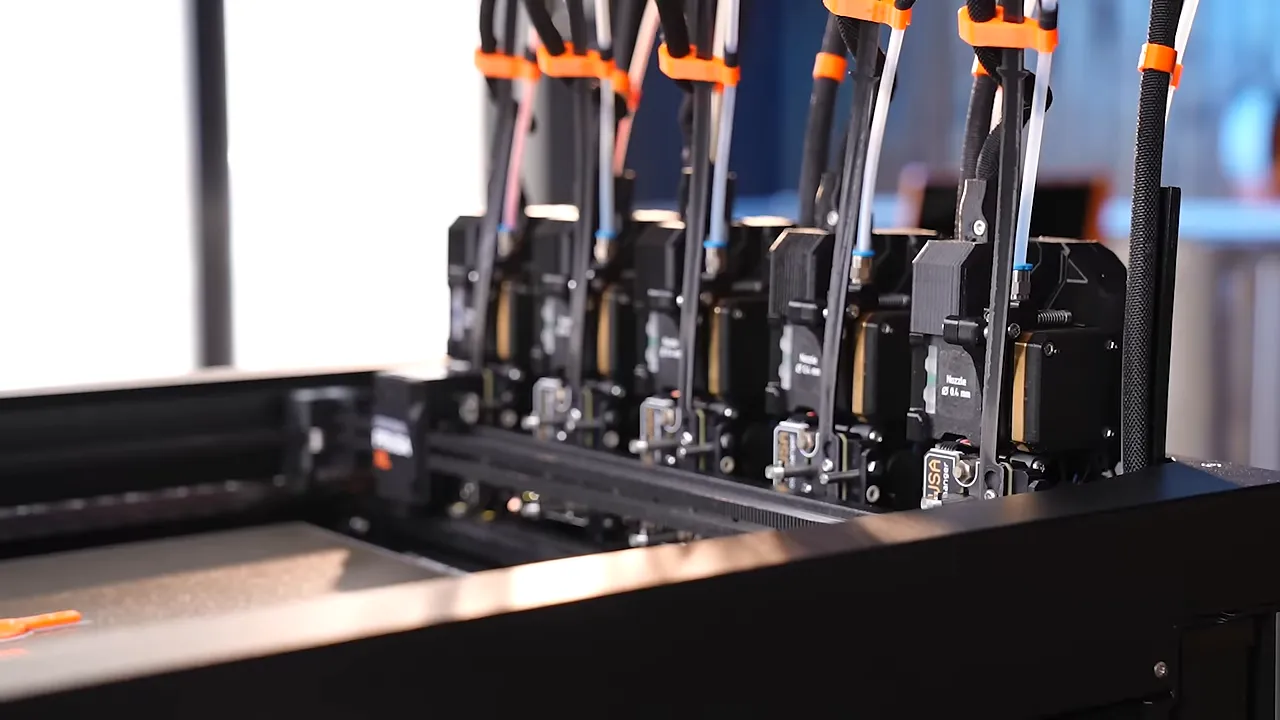
The XL’s biggest advantage is its tool-changing system. Each head can stay loaded with its own color or material, ready to go.
At first glance, the arrangement looks complicated. There are heads parked across the back, filament tubes looping overhead, and a lot going on mechanically. But the idea behind it is straightforward: change the tool instead of changing the filament inside one tool.
With a single-nozzle multicolor system, such as an X1 Carbon paired with an AMS, a material change involves several steps:
- Unload and retract the filament currently in use.
- Feed the next filament into the same print head.
- Purge enough material to clear the previous color or material.
- Resume printing the part.
That process takes time, creates opportunities for feeding problems, and consumes filament that never becomes part of the finished object.
The XL takes a different route. It parks the active head, picks up another one, purges a small amount, and gets back to work.
Repeat that hundreds of times, and the savings can become enormous. The important word there is can.
Prusa XL vs. Bambu X1 Carbon: The Price Problem
At the prices used in this comparison, the five-head XL cost approximately:
- $3,500 semi-assembled.
- $4,000 fully assembled.
The X1 Carbon with an AMS was around $1,450, less than half the price of either five-head XL configuration.
Yes, the X1 Carbon has a smaller build volume, roughly 10 inches in each direction rather than 14. Yes, it has only one print head. But it is still a very capable, fast machine.
To see how much the XL’s tool-changing advantage mattered in practice, I compared the same multicolor part in both slicers. In that first example, the XL’s overall time advantage was not particularly dramatic. Certainly not dramatic enough, in my judgment, to make the price premium an obvious choice.
That is the distinction that gets lost in a feature comparison: faster material changes do not automatically mean a dramatically faster finished print. If a job spends most of its time laying down plastic rather than swapping colors, there is less overhead for the XL to eliminate.
Size alone does not settle the argument
What if the XL’s value is simply that it is bigger?
The Elegoo OrangeStorm Giga complicates that argument. Its build volume is about 13.5 times the XL’s, and even one quadrant of its bed is larger than the XL’s print area. At the pricing discussed here, it cost about the same as a single-head XL.
That does not make the Giga a direct substitute for a five-tool Prusa. It makes a narrower point: a large build volume, by itself, is not enough to explain the XL’s price.
So if the independent heads are the real reason to buy this machine, we need a job that pushes them.
The Four-Color Benchy Test: Where the XL Pulls Away
Enter the four-color Benchy torture test.
I will admit it: I am not a big Benchy fan. I think 3D printing gets tied to toys and trinkets too often, when these machines can do so much more. But the little boat from the 3DBenchy benchmark project is useful here because this particular color layout forces constant changes.
Each color is used for only a short stretch before the printer needs another one. That means the time spent changing and purging filament becomes a huge part of the job.
This is exactly the kind of workload where the XL should shine. And it does.
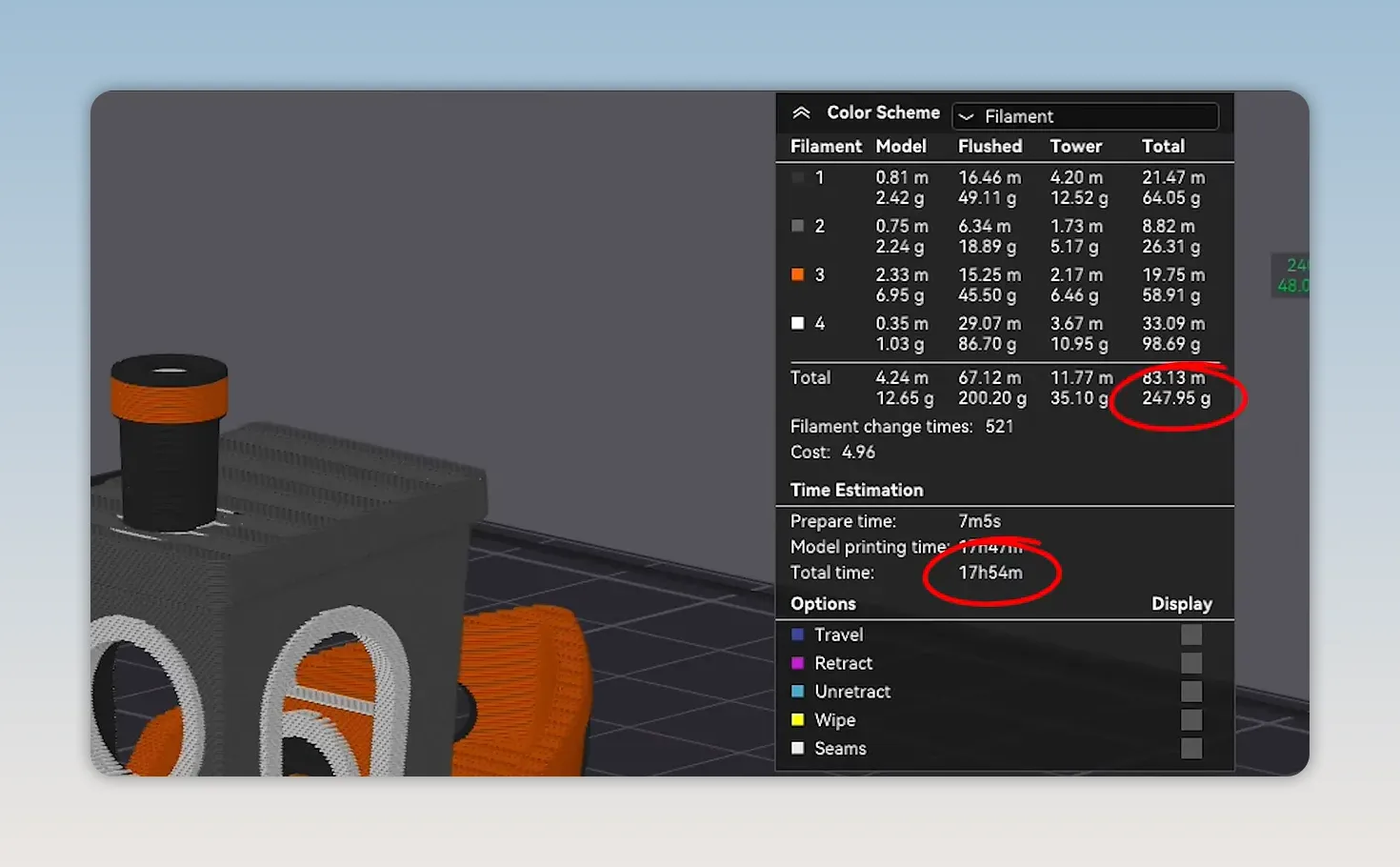
The slicer estimates
- Prusa XL: About 2.5 hours, just over 24 grams of filament, and 455 tool changes.
- Bambu X1 Carbon with AMS: Almost 18 hours, roughly 10 times as much filament, and 521 filament changes with associated purging.
That is approximately a sevenfold difference in estimated completion time for the same small part. The normally speedy X1 Carbon spends much of this job dealing with filament changes rather than making the boat.
What actually finished
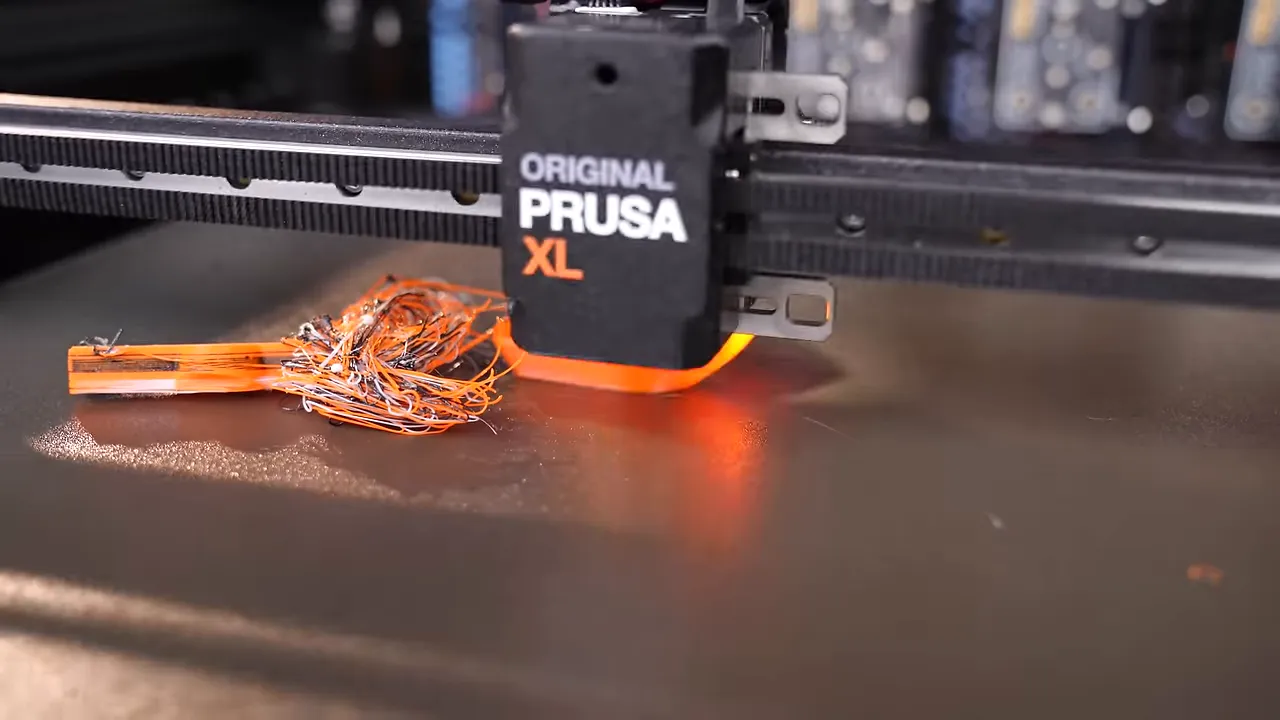
I printed the test on the XL, and it finished in the promised two and a half hours.
It was not a flawless run. The purge tower fell over partway through, and the finished print quality was not amazing. That is worth saying alongside the impressive timing.
I also started the X1 Carbon print, got tired of waiting, and canceled it. So the nearly 18-hour figure is a slicer estimate, not a completed timed result.
Even with that limitation, the comparison makes the XL’s strength obvious. When a model requires hundreds of short color changes, independent tools can save a ridiculous amount of time and material.
The question is how often your work looks like that.
An Amazing Machine With a Narrower Audience Than Its Name Suggests
My deliberately blunt reaction to the XL was that it is an amazing machine with almost nobody to recommend it to.
That is an exaggeration, obviously. The four-color test proves there are jobs where it has a major advantage. If you regularly make multicolor or multimaterial parts with lots of changes, the savings deserve serious consideration.
But we had to choose an extreme example to make the advantage this dramatic. That does not make the result meaningless. It does make it workload-specific.
For someone whose multicolor work resembles my first comparison, the cheaper X1 Carbon remains a difficult machine to ignore. For someone primarily chasing size, there are other large-format options. The XL’s strongest case sits at the intersection of those needs, particularly when frequent tool changes matter.
That is a pretty specialized audience for a flagship carrying this kind of price tag.
Why the BlackBerry Comparison Worries Me
The BlackBerry analogy is not about Prusa suddenly forgetting how to build reliable machines. It is about making incremental improvements to a familiar product while competitors change what customers consider normal.
The MK4 addresses annoyances in the MK3 design, and those improvements matter to existing owners. But a color screen and 32-bit electronics are not exactly earth-shattering reasons for the broader market to get excited.
What is this, 1993? Does it come with a free AOL CD-ROM?
Joking aside, my concern is not that better electronics are bad. It is that catching up on expected features is different from setting a new standard.
The MK4’s input shaping also arrived months after the printer’s release. To me, that reinforced the feeling that the hardware reached the market before its full speed story was ready.
Again, that is my interpretation of the rollout, not proof of a panicked launch strategy.
Prusa Is a Big Ship to Turn
It is easy to criticize a successful company from the comfort of a workshop. Actually changing its direction is another matter.
Prusa has a large installed base of printers and a real responsibility to keep supporting those customers. It also has manufacturing operations built around its existing products. Deciding to start over is not as simple as sketching a different printer frame.
The company’s manufacturing setup is genuinely impressive. It has brought substantial work in-house, including injection molding and PCB manufacturing.
My guess is that supply-chain disruption during COVID helped motivate some of that investment, but that is speculation too. Regardless of the motivation, the capability itself is significant.
Those resources could be a major strength. They also help explain why a company with established products, factories, and customers cannot pivot like a brand-new entrant.
What I Hope Prusa Does Next
The optimistic interpretation is that the MK4 and XL serve two different purposes.
The MK4 is the long-planned refinement of the familiar i3 platform: fix the frustrating bits, improve the experience, and serve the people already invested in that design.
The XL, meanwhile, could point toward the more important future: CoreXY machines with meaningful differentiation.
That future does not have to look like a five-headed Medusa. I would love to see Prusa take what it has learned from the XL and use it to compete more directly with the growing field of approachable CoreXY printers.
My wish list is straightforward:
- Compete on the complete experience. Reliability matters, but so do convenience, speed, and how little effort it takes to get a finished part.
- Build on genuinely distinctive engineering. The XL’s tool-changing system solves a real problem, even if its biggest gains apply to specialized jobs.
- Make the value proposition easier to understand. Buyers should not need a torture test to see why a machine fits their work.
- Do not rely on expensive bed-slinger refinements as the main path forward. Improving an established platform is not the same as answering a market shift.
I worry that staying on the same course could push Prusa toward a much smaller, less relevant corner of the market. That is a fear about its direction, not a declaration that the outcome is inevitable.
Prusa has the engineering talent, manufacturing capability, reputation, and community to remain important. I want to see those strengths applied to products that make the competition nervous again.
The XL shows that Prusa can still build something fascinating. The next challenge is making something just as easy to recommend.
Disclosure: Prusa supplied the XL for me to test. That does not change the concerns or conclusions above.
Sponsor: Factor
Busy shop days have a way of turning meal planning into whatever happens to be nearby. Factor, the sponsor supporting this work, delivers fresh, never-frozen meals that are chef-crafted and dietitian-approved. I have found the convenience useful, and the food is genuinely good.
The service offers more than 30 weekly options and lets you skip a delivery when you are away. The promoted offer uses code SHOPNATION50 for 50% off your first box, plus two free wellness shots with each box for as long as your subscription remains active.


